Pick your finish, tell us the size of your garage, and see a real installed price range in about 60 seconds. No email wall in front of the number.
16+Years in Maryland
10 yrWritten Warranty
1 dayBack in Service
#111360MHIC Licensed
1How big is the space?
Pick a garage size, or Basement. Not sure? Pick the closest — we confirm exact square footage at the on-site check.
1-Car~250 sq ft 12×20 typical
2-Car~380 sq ft 20×20 typicalMost common
3-Car~620 sq ft 30×22 typical
BasementBelow-grade slab ~800 sq ft typicalNew
I know my sizeEnter exact sq ft
Length × width of the slabWe price garages and basements from 100 to 1,000 sq ft here. For anything larger, call us at 240-444-0748 — big floors are priced after a site check, because the rate per square foot changes with size.
2Which finish?
Three different floors, three different prices. Same diamond grind and the same 100% solids base under all of them.
Decorative flakeVinyl chips broadcast into the base coat. Hides dirt, adds grip, forgiving underfoot.Most popular
MetallicPearlescent pigment moved by hand into swirls and ripples. No two floors alike.Premium
Solid colorOne clean pigmented color, no chips. The most affordable professional build.Best value
3Pick your flake blend
These are real broadcast blends. Tap one to see it up close, the way it lands on the floor.
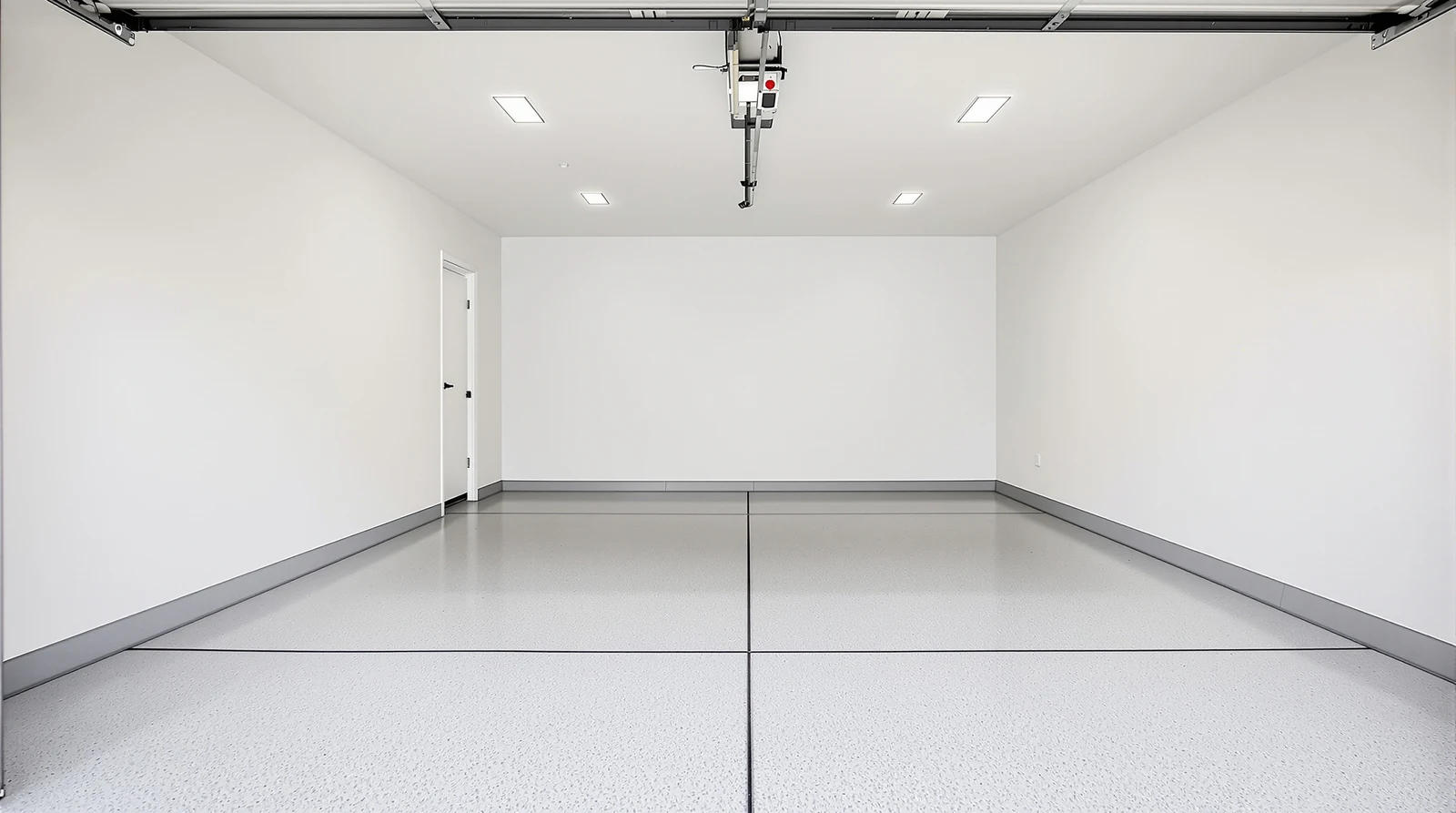
Simulated on a 2-car garage
Basement room preview with your finish is coming. Until then, this is a close-up of the finish itself.
Domino · full broadcast
Flake coverage
Full broadcastFlake to refusal — no base color shows. The showroom look.Standard
Light scatterBase color visible between flakes. Costs less, reads more industrial.
Why metallic costs more. The material is only a little dearer than flake. The difference is the install: the pigment has to be worked into its pattern by hand before the epoxy starts to set, and there is no second attempt. You are paying for the hour that cannot be rushed.
4Choose your topcoat
This is the single biggest price lever, and the one that decides how the floor ages.
Epoxy clearCosts less. Can amber where direct sun hits it. Longer cure before you park on it.
PolyasparticUV stable — will not yellow. Back in service in about a day.We recommend
5Moisture and access
A basement slab sits below grade, so we test it for moisture before we confirm the number. A moisture barrier primer is included in this estimate until the reading says otherwise — if your slab tests dry, that line comes off. Everything is carried in by hand, so stairs and tight doors are priced in.
Finished walls with baseboards?
Unfinished basement? Skip this. If you have trim along the walls, pick how you want the edge handled.
Leave baseboards onWe tape the trim and cut in along it. A thin line can show where the floor meets the trim.
Take them off and put them backCleanest edge: the floor runs tight to the drywall. Priced per foot of wall.Cleanest edge
5How old is the slab?
Older slabs often lack a vapor barrier. Our system handles up to 12 lb of moisture vapor transmission, so most slabs pass — but we measure rather than guess, in both directions.
Built after 1990Vapor barrier likely present. We moisture test to confirm.
Before 1990 / block wallsWe test first. Most still pass — primer only if the reading calls for it.
Not sureWe test on site. If it comes up damp we quote the primer then.
Your estimated price
—
—
—
Why a basement costs more than a garage
It is a different job. Every bucket is carried down the stairs, grinding dust has to be contained indoors, the room needs ventilation while the topcoat cures, and the slab sits below grade so it gets a moisture test and a barrier primer. Columns, drains and walls add cut-in work. That is why the rate per square foot is higher.
How this compares
Published range for garage floor coatings is $5–$12 per sq ft — about — for a garage your size.
That range is wide because it covers two different products. The bottom of it is acid-etch prep with a thin single-coat system, roughly 3–6 mils. What we install — diamond grind to CSP-3, 100% solids base, full flake broadcast, polyaspartic topcoat — is over 50 mils and sits at the top of that band.
You are at —.
Estimate only. Final price is confirmed after an on-site slab inspection — crack condition, joint count, and moisture reading can move it. We put the confirmed number in writing before any work starts.
We will confirm your square footage and email the written estimate. No spam, no drip sequence.
Prefer to book the on-site check now? Call 240-444-0748. Deposits are taken at contract signing, never online through this page.
Thinking of doing it yourself?
The full cost of DIY, nothing left out
A kit on the shelf looks like $175. It is not what you actually spend. Here is everything a homeowner pays for a 2-car garage (380 sq ft), including waste, tax, tools, clothes, tape, plastic, trips and your own time. Items we could source are sourced. The rest are marked as our estimates, so you can swap in your own numbers.
Store-bought kit
Pro-grade kit, same system as ours
USA Pro Floors flake system
Coating materialsBig-box: two kits. Each label says 450–500 sq ft, but ground concrete drinks more and reviewers report 200–250 sq ft per kit.
$350 – $400
$900 – $1,100
included
Waste, spills, leftover mix (15–20%)Our estimate.
$52 – $80
$135 – $220
included
Grinder day, dust vacuum, diamond toolingBig-box low end is an etch kit instead of a grinder. Rental rates from installer sources, not a Maryland rental yard.
$60 – $300
$200 – $450
included
Moisture test kit
$36 – $39
$36 – $39
included
Respirator and cartridges, gloves, suit, work boots, spiked shoesCartridges and spikes sourced; the rest is our estimate.
Maryland sales tax, 6%Rate from the Maryland Comptroller.
$42 – $76
$89 – $139
included
Gas, pickup trips, disposalOur estimate.
$30 – $80
$30 – $80
included
Cash out of your pocket
$770 – $1,425
$1,610 – $2,528
$3,312 – $3,888
Your time (20–30 hrs vs 30–40 hrs at $25/hr)Use your own hourly number. Ours is a modest $25.
$500 – $750
$750 – $1,000
$0
All in, with your time
$1,270 – $2,175
$2,360 – $3,528
$3,312 – $3,888
How long it lasts
3–5 yearsCost guides; manufacturers publish no lifespan.
Same materials as ours. Lasts as long as your prep does.
10–20 years
Be fair to DIY
Look at the cash line. A pro-grade kit done well can cost less than we charge, and we are not going to hide that. What you are buying from us is the part that is hard to buy at a store: diamond grinding to CSP-3 with commercial dust control, a moisture test before anything goes down, a trained crew that finishes in 3 days, and nothing for you to redo.
The risk sits in the cheap column. If a store-bought floor lasts the 3 to 5 years the cost guides report, you do it again two to four more times over fifteen years. At the cash prices above, that is about $2,310 – $7,120 and three to five rounds of stripping what is left of the last coat. One professional floor over the same fifteen years is $3,312 – $3,888, once.
Want the exact number for your garage? Use the calculator above or call 240-444-0748.
Why DIY floors fail early
It is almost never the product. Skipping surface preparation is the single most common cause of peeling, and the second is coating a slab that was damp when it went down. A rented grinder for a day is not the same as grinding to a CSP-3 profile, and an etching solution is a chemical rinse, not a profile at all.
That is the whole difference. The epoxy in the bucket is fine. What it is stuck to is the job.
How much does an epoxy garage floor cost in Maryland?
A standard 2-car garage of about 380 square feet runs roughly $3,100 with an epoxy clear topcoat and about $3,600 with polyaspartic, installed. The published range for garage coatings is $5 to $12 per square foot — wide, because it spans two different products. The low end is acid-etch prep with a thin single-coat system, 3 to 6 mils. A diamond-ground, 100% solids, full-flake, polyaspartic build is over 50 mils and sits at the top of that band. Price per square foot also drops as the garage gets bigger, because grinding setup and mobilization are fixed costs spread over more floor.
Why is polyaspartic more expensive than epoxy clear?
The material itself costs more — roughly $600 for four gallons versus about $225 for the epoxy base. What you get for it is UV stability, so the floor will not amber where sun comes through the garage door, and a cure fast enough to park on it the next day. If your garage gets real direct sunlight, this is the one upgrade worth taking.
What is the moisture barrier primer and do I need it?
Usually not. Our flake system tolerates moisture vapor transmission up to 12 lb per 1,000 sq ft per 24 hours (ASTM F1869), or 85% relative humidity in the slab (ASTM F2170) — a high ceiling that most Maryland garages clear, including older ones. We test every slab before quoting rather than assuming from the build year. When a reading does come back over the limit, we add the primer, about $280, and show you the number that justified it. We will not sell you a primer because your house is old, and we will not skip the test because it looks dry.
Why does grinding matter more than the coating brand?
Because adhesion is everything, and nearly every failure traces back to preparation rather than product. We diamond grind to open the concrete profile so the epoxy keys mechanically into the slab. Crews that acid etch instead are doing a chemical wash that leaves a much weaker bond. That difference does not show up for two years, and then it shows up all at once.
How long before I can park on it?
Foot traffic in about 24 hours. Vehicle traffic at 72 hours with polyaspartic. Hot tire pickup — where warm tires lift the coating — happens when a car goes on too early, so we hold that line even when a customer wants to rush it.
What is not included in this estimate?
Significant crack and spall repair, pitted slab resurfacing, extra control joint cutting, and removal of an existing failed coating are all quoted separately once we see the slab. This calculator prices a sound slab in normal condition, which is most of them.
 Simulated on a 2-car garage